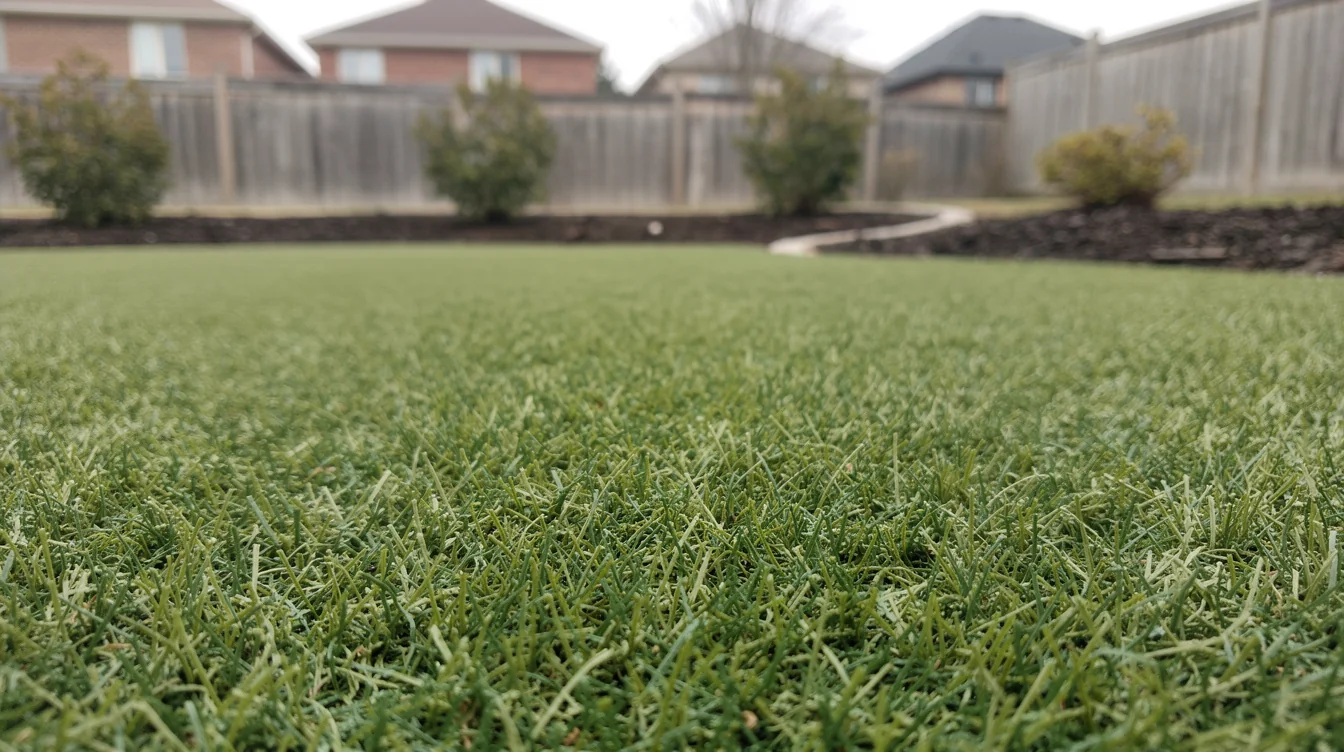
Short answer: no, if it's installed properly. Yes, if it isn't. Most Windsor homeowners considering [artificial lawn installation](/) ask this question for good reason. Essex County's heavy clay soil holds moisture. Freeze-thaw cycles push weed seeds upward each spring. And a turf install that skips the sub-base or weed barrier leaves the door wide open for crabgrass and dandelions within two summers. We'll walk through how weeds actually break through artificial grass, the four-layer system that stops them, the shortcuts that bring them back, and what to ask a contractor before you sign anything.
How Weeds Get Through Artificial Grass in the First Place
Almost every weed problem we see on residential turf in Windsor and Essex County traces back to one of three failure modes.
First, airborne seeds land on the surface. Wind carries dandelion, crabgrass, and chickweed seeds onto the turf, where they settle into the infill. Damp infill is common in shaded yards and after a rainy stretch. When the seeds find moisture, they germinate and root downward.
Second, existing weed roots in the soil below survive the install. If the original lawn wasn't excavated to a sufficient depth, established roots push upward through any gap they can find: seams, edges, drainage holes.
Third, edges and seams aren't sealed. Improperly secured perimeter strips and DIY-grade edging create lateral entry points. Weeds from adjacent garden beds or flower borders creep in sideways, not vertically.
The Four-Layer System That Stops Weeds Cold
A proper install in the Windsor climate uses four stacked layers, each doing a specific job.
**Layer 1: Excavation (2–3 inches deep).** Existing sod, root systems, and the top organic layer of soil are all removed. This kills the food source established weeds rely on. In clay-heavy yards across Essex County, we go deeper to address drainage issues at the same time.
**Layer 2: Compacted crushed-stone sub-base (3–4 inches).** A graded layer of crushed limestone, compacted to roughly 95% density. Roots can't penetrate compacted aggregate at this depth, and water drains through it rather than pooling.
**Layer 3: Geotextile weed barrier.** A woven landscape fabric laid between the sub-base and the turf backing. It blocks any seeds or roots from below while letting water pass through. This is the layer DIY installs skip most often.
**Layer 4: Turf with permeable backing and sealed seams.** Modern landscape turf has perforated backing that drains downward. Seams are joined with professional-grade adhesive and seam tape. Edges are anchored with galvanized spikes through the geotextile into the sub-base. No gaps.
The Shortcuts That Bring Weeds Back (Avoid These)
Every weed problem we've been called to fix traces back to one of four install shortcuts.
**Skipping excavation.** Laying turf directly on top of existing grass. The old root systems survive, and within 18 months they push through. This is the single most common DIY mistake.
**No geotextile barrier.** Saves about $0.50 per square foot up front, costs you a re-install within 3–5 years. Without the woven fabric layer, anything germinating in the infill above has a clear path to the soil below.
**Sand instead of crushed stone.** Sand doesn't compact the way limestone does. It shifts under load, creates pockets, and gives roots a softer substrate to work through. Some contractors use it because it's cheaper to haul and spread. It's a false economy.
**Unsecured perimeter.** Plastic landscape edging stapled at the top isn't enough. Without a secured edge anchored through the geotextile, weeds from adjacent garden beds work in laterally at the boundary.
What to Ask a Windsor Contractor Before You Sign
Five questions tell you almost everything about whether the install will hold up.
**1. How deep will you excavate?** The right answer is 2–3 inches minimum, more in heavy clay. If a contractor says they'll just "lay it on top," thank them for their time and move on.
**2. What sub-base material and depth?** Crushed limestone, 3–4 inches compacted. "We use a thin layer of sand" is a red flag.
**3. Do you install a geotextile weed barrier?** Yes is the only acceptable answer. Ask to see the fabric they use. Reputable brands include US-based Mirafi or DeWitt commercial-grade landscape fabric.
**4. How are edges secured?** Galvanized turf spikes through the fabric into the sub-base, on 6-inch centres. Surface staples alone aren't enough.
**5. What's the warranty on weed-related callbacks?** A real installer stands behind weed prevention for at least the first 3–5 years. A vague warranty or one that excludes "acts of nature" is hedging against a bad install.
Reputable [backyard turf installation Windsor](/services/backyard-turf/) contractors walk through all of this on the estimate visit without being asked. If you have to push for specifics, that's a sign.
Frequently Asked Questions
Will weeds eventually grow through any artificial turf, no matter how it's installed?
No. A properly installed system stops weeds for the 15-to-20-year lifespan of the turf. That means 2 to 3 inches of excavation, a compacted crushed-stone sub-base, a geotextile weed barrier, and sealed edges. Where weeds appear, the cause is almost always one of those layers being skipped or under-spec'd during installation.
Do I need to remove all existing grass before installing artificial turf in Windsor?
Yes, plus the top 2–3 inches of soil holding the root systems. Spraying with herbicide and laying turf on top is the most common DIY shortcut and the most common reason weed problems show up by year two. Full excavation removes the food source weeds need to come back.
Can I use weed killer on artificial turf to keep weeds from coming through?
You can, and most homeowners spray a residential weed killer on the surface once or twice a season as light maintenance. But chemical treatment is a band-aid. It kills what's already growing in the infill, not what's pushing up from below. If weeds keep returning, the install has a structural problem.
How long should weed-free artificial grass last in Windsor's climate?
Mid-range residential turf installed on a proper sub-base with a geotextile barrier holds up weed-free for 15–20 years in Windsor's climate. Freeze-thaw cycles and humid summers don't change the lifespan if drainage and barrier layers are right. The turf fibres themselves wear out before weed pressure becomes a problem.
Is it worth fixing a bad turf install if weeds are already coming through?
Sometimes. If weeds are isolated to edges or seams, a targeted repair with new edging and spot herbicide can buy you years. If weeds are coming through the field of the lawn, the sub-base or barrier wasn't installed correctly and a re-install is usually the only durable fix.
Ready to Get Started in Windsor?
Windsor Turf Pros serves Windsor and the surrounding area. Get a free, no-obligation quote today.